
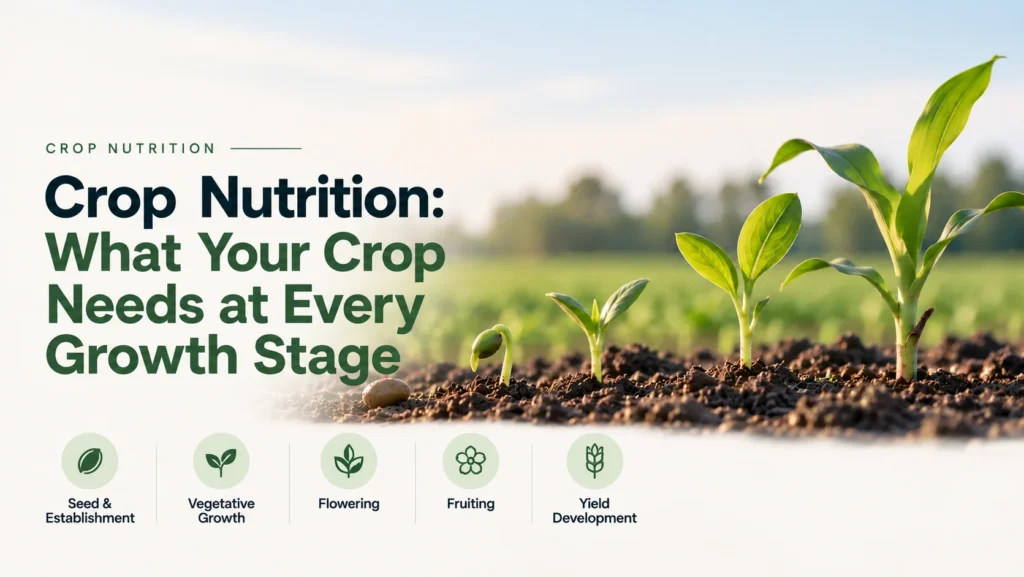
Crop Nutrition: What Your Crop Needs at Every Growth Stage
A healthy crop doesn’t need the same nutrition throughout its entire growing cycle.
From the moment a seed starts developing roots to vegetative growth, flowering, fruiting and grain development, the crop’s requirements continue to change.
Providing nutrients according to the crop, growth stage and specific requirement can help create better conditions for healthy crop development.
This is why crop nutrition should not simply be viewed as applying fertilizer once or twice during the season.
It is better understood as a stage-wise approach to crop management.
Why Does Crop Nutrition Matter?
Plants require different nutrients for processes such as root development, vegetative growth, flowering, fruit formation and grain development.
But the requirement isn’t identical at every stage.
For example:
Early stage → Root establishment & vegetative growth
Flowering stage → Reproductive development
Fruiting / grain stage → Fruit, pod or grain development
Therefore, understanding when and why a crop needs nutritional support is just as important as selecting the product.
Understanding the Crop Growth Journey
A simple way to understand crop nutrition is to look at the crop as a journey:
🌱 01 — Seed & Establishment
The crop begins developing its root system and establishing itself in the soil.
🌿 02 — Root & Vegetative Growth
The plant develops roots, stems and leaves and establishes its vegetative framework.
🌾 03 — Active Crop Growth
The crop continues developing biomass and requires balanced nutritional support.
🌸 04 — Flowering
The crop enters an important reproductive stage.
🍎 05 — Fruiting / Grain Development
The focus shifts towards fruit, pod or grain development depending on the crop.
🌾 06 — Yield Development
The crop progresses towards maturity and harvest.
1. Nutrition Starts With a Strong Foundation
Before thinking about flowering or yield development, the crop needs a healthy foundation.
This includes:
- Good root development
- Suitable soil conditions
- Nutrient availability
- Adequate moisture
- Healthy crop establishment
Products such as Phour Mycorrhiza are positioned around the root–soil interface and nutrient absorption, while Phour Azotobacter + PSB is positioned as a biofertilizer supporting nitrogen fixation and phosphorus availability.
The specific product and application method should always be selected according to the crop and recommended label directions.
2. Vegetative Growth — Build the Crop
During vegetative development, the crop is actively producing leaves, stems and other plant structures.
This is an important stage for establishing the crop’s growth potential.
PhourAgro’s catalogue includes products such as:
Phour Azoteeka Plus-E
An Azotobacter + Zinc + Iron + PSB formulation listed for cereals, vegetables, fruits and cash crops. The catalogue describes its use during the vegetative stage through foliar spray, soil drench or drip application.
Phour N.P.K. 19:19:19
A water-soluble NPK formulation listed for use during the vegetative stage.
The key point is simple:
Vegetative nutrition should be managed according to crop requirement rather than applying nutrients without considering the growth stage.
3. Micronutrients Matter Too
Crop nutrition isn’t only about N, P and K.
Micronutrients can also be important when a crop has a specific deficiency or requirement.
One example is zinc.
PhourAgro has two zinc-focused products:
Phour Zinc Power (Liquid)
A chelated zinc formulation containing 12% EDTA-chelated Zn, listed for cereals, vegetables and fruits with zinc deficiency.
Phour Zinc Granule
Listed as Zinc Sulphate Monohydrate with 33% Zn, intended for crops where zinc deficiency is identified in the soil.
This highlights an important principle:
Nutrient selection should be based on the actual crop requirement and deficiency condition.
4. Flowering Is a Different Stage
As the crop moves from vegetative development towards flowering, its nutritional requirements can change.
This is where stage-specific nutrition becomes particularly relevant.
PhourAgro’s catalogue includes products such as:
Phour Bhoomi-K
A potash-focused product listed for oilseeds, fruits and vegetables, with application timing around flowering through fruit ripening depending on the crop.
Phour N.P.K. 0:52:34
The catalogue lists this water-soluble formulation for the flowering to fruit/grain stage.
Phour Boron Rich
This product is included in the PhourAgro catalogue as a Flowering & Fruit-Set Specialist. However, the product details available in the catalogue material we have do not provide enough information for us to specify its exact formulation or dosage here.
5. Fruit, Pod & Grain Development
After flowering, the crop moves into another important stage.
Depending on the crop, this may involve:
- Fruit development
- Pod formation
- Grain development
- Yield formation
For example, Phour Up-Gro is listed for wheat and pulses and is positioned around flowering to grain/pod filling.
The catalogue lists:
Wheat: 400 ml/acre at flowering
Pulses: 300 ml/acre at pod formation
Always use the final approved product label for application instructions before publishing or applying these recommendations.
Paddy Needs Its Own Nutrition Approach
Different crops have different growth patterns.
For paddy, PhourAgro has a crop-specific product:
Phour Paddy Booster
The catalogue describes it as a liquid NPK + micronutrient complex specifically for paddy.
It is listed for:
Tillering: 500 ml/acre
Panicle initiation: 300 ml/acre
The product is intended for foliar application at these stages.
This is a good example of why crop nutrition should be considered in relation to both:
Crop + Growth Stage
A Simple Stage-Wise Nutrition Framework
You can think about crop nutrition like this:
| Crop Stage | Main Focus |
|---|---|
| Seed & Establishment | Root establishment |
| Root Development | Root-zone support |
| Vegetative Growth | Plant development |
| Flowering | Reproductive development |
| Fruiting / Pod Formation | Fruit or pod development |
| Grain Development | Grain filling & crop maturity |
The exact nutritional requirement will vary according to the crop, soil condition and growing environment.
Why One Product Isn’t Enough for Every Situation
There is no single nutritional solution that automatically fits every crop and every stage.
For example:
Wheat may require a different approach from paddy.
Vegetables may have different requirements from fruit orchards.
Similarly, a product suitable for vegetative growth may not be the appropriate choice for flowering or fruit development.
That’s why product selection should consider:
Crop
What are you growing?
Stage
Where is the crop in its growth cycle?
Requirement
What does the crop actually need?
Application
Which method and dosage are recommended?
PhourAgro’s Stage-Wise Product Approach
Some examples from the PhourAgro range include:
🌱 Root & Establishment
Mycorrhiza
Azotobacter + PSB
RootMax
🌿 Vegetative Growth
Azoteeka Plus-E
N.P.K. 19:19:19
🧪 Micronutrient Support
Zinc Power
Zinc Granule
🌸 Flowering
Bhoomi-K
N.P.K. 0:52:34
Boron Rich
🌾 Grain / Pod Development
Up-Gro
🌾 Paddy-Specific Growth
Paddy Booster
These are examples based on the product catalogue’s stated positioning and application stages, not a universal recommendation for every farm.
5 Things to Remember About Crop Nutrition
01 — Know Your Crop
Different crops have different nutritional requirements.
02 — Understand the Growth Stage
Nutrition should be considered according to where the crop is in its growth cycle.
03 — Don’t Ignore Micronutrients
Nutrients such as zinc can become important when deficiencies or specific crop requirements exist.
04 — Follow the Recommended Application
Dosage and application method vary by product and crop.
05 — Look at the Complete Crop
Nutrition works alongside soil condition, water management, root development and other crop-management practices.
Final Takeaway
Good crop nutrition is about timing, balance and the right application.
Instead of asking only:
“Which fertilizer should I use?”
a better starting point is:
“What does my crop need at this stage?”
Understanding the crop’s growth journey can help you make more informed decisions about nutrition and crop-care inputs.
Right Crop → Right Stage → Right Nutrition → Better Crop Management