
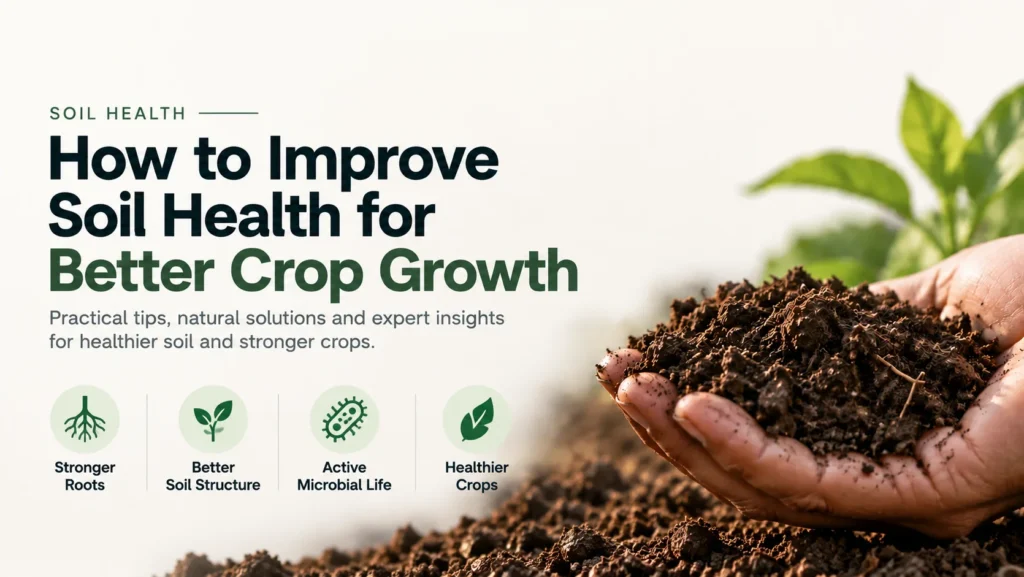
Introduction
Healthy crops begin with healthy soil.
Before a crop develops strong roots, healthy leaves, good growth and productive flowering, it needs a suitable soil environment. Soil provides the physical support, water and nutrients that crops need throughout their growing cycle. When soil structure, nutrient availability and biological activity are not properly managed, crop development can be affected.
That is why soil health should be considered an important part of crop management — not just a pre-sowing activity.
From improving the root zone to supporting nutrient availability, a well-managed soil environment can help create better conditions for crop growth.
In this guide, we’ll look at some practical aspects of soil health and how farmers can approach soil and root-zone management more effectively.
What Is Soil Health?
Soil health refers to the ability of soil to provide a suitable environment for plants while supporting physical, chemical and biological processes.
Healthy agricultural soil generally needs:
- Good soil structure
- Adequate moisture-holding capacity
- Balanced nutrient availability
- Healthy root-zone conditions
- Beneficial microbial activity
- Good aeration and drainage
These factors work together.
For example, even when nutrients are present in soil, plants may not be able to use them effectively if the root zone is poorly developed or soil conditions restrict root growth.
Healthy soil → Better root environment → Better crop development
Why Soil Health Matters for Crop Growth
A crop’s root system is its connection to the soil.
Roots need access to water, nutrients and oxygen while also establishing a stable root network. Therefore, the condition of the root zone can influence how efficiently a crop develops.
1. Better Root Development
A healthy root zone provides space for roots to establish and expand.
Stronger root development can help plants explore a larger area of soil for available water and nutrients.
2. Better Nutrient Availability
Soil nutrients need to be available in forms that plant roots can access.
Biological and soil-management approaches can support nutrient availability and nutrient-use processes.
3. Better Soil Structure
Good soil structure supports movement of air and water through the root zone.
PhourAgro’s Black Gold, listed as a phosphate-rich organic manure, is positioned in the catalogue for soil applications and describes benefits related to soil aeration, structure and water-holding capacity.
4. Support for Soil Microbial Activity
Soil is also a biological environment.
Beneficial microorganisms can play an important role in nutrient cycling and the interaction between soil and plant roots.
5 Practical Ways to Improve Soil Health
1. Start With the Root Zone
Don’t look at the crop only from the surface.
The root zone is where the plant interacts directly with soil. Supporting root development from the beginning can help establish a stronger foundation for crop growth.
Phour Mycorrhiza is designed around VAM fungi and is listed for cereals, pulses, oilseeds, vegetables, fruit and plantation crops. The catalogue describes its role in extending the effective root absorption area, particularly for phosphorus, and improving the root–soil interface.
Suitable approach:
Use according to the product label and recommended application method at sowing or transplanting.
2. Support Beneficial Soil Microorganisms
Microbial activity is another important part of a healthy soil environment.
Phour Azotobacter + PSB combines Azotobacter and phosphate-solubilizing bacteria and is positioned as a biofertilizer for soil health.
The catalogue lists suitable crops including wheat, paddy, maize, bajra, sugarcane, vegetables and fruits. It also describes nitrogen fixation and phosphorus solubilization as key functions.
Its listed application methods include:
- Seed treatment
- Soil drench
- Drip irrigation
The catalogue specifically advises avoiding direct mixing with chemical fertilizers and pesticides.
3. Improve Soil Structure and the Root Environment
Soil that is compacted or poorly structured can create an unfavourable environment for roots.
Organic matter and suitable soil amendments can be part of a broader soil-management approach.
Phour Black Gold is listed as a Phosphate Rich Organic Manure (PROM) with a composted organic base enriched with humic and fulvic acid. The catalogue describes its intended use for field crops, vegetables and fruit orchards, with basal soil application before sowing or transplanting.
The catalogue lists:
- Cereals & pulses: 50 kg/acre
- Vegetables: 40 kg/acre
- Fruit orchards: 2–5 kg/tree depending on age
Always follow the final product label and crop-specific recommendation before application.
4. Pay Attention to Root Establishment After Transplanting
For horticultural crops, nursery plants and fruit trees, early root establishment is especially important.
Phour RootMax is positioned as a horticulture specialist and is intended for horticultural and plantation crops, nursery plants, fruit trees and ornamentals.
The catalogue describes its use around the root zone and nursery mix, particularly at transplanting and early establishment.
Listed examples include:
- New fruit plants: 200–300 g/pit
- Nursery/ornamentals: 50–100 g/plant or pot
- Field horticulture crops: 3–4 kg/acre
5. Don’t Treat Soil Health as a One-Time Activity
One of the biggest mistakes in crop management is looking at soil health only before sowing.
A crop passes through multiple stages:
Seed
↓
Root Development
↓
Vegetative Growth
↓
Flowering
↓
Fruiting / Grain Development
↓
Harvest
The requirements of the crop can change at every stage.
That means soil and crop nutrition should be considered as part of an overall crop-management strategy, rather than as a single application.
Soil Health and Crop Nutrition Work Together
Healthy soil alone does not automatically guarantee good crop performance.
Crop nutrition also needs to be managed according to:
- Crop type
- Soil condition
- Growth stage
- Nutrient requirement
- Application method
- Local agronomic recommendations
PhourAgro’s product range includes soil, root and nutrition-oriented products such as Mycorrhiza, Azotobacter + PSB, Black Gold, RootMax and N.P.K.
The right product should therefore be selected according to the crop requirement and recommended application stage, rather than simply using more inputs.
A Simple Soil Health Approach
You can think about soil management through four basic areas:
🌱 01 — Build the Soil Environment
Focus on soil structure, organic matter and suitable soil-management practices.
🌿 02 — Support the Root Zone
Create better conditions for roots to establish and expand.
🦠 03 — Support Soil Biology
Consider beneficial microbial solutions where appropriate.
🧪 04 — Manage Crop Nutrition
Provide nutrients according to crop requirement and growth stage.
This creates a more complete approach:
Soil → Roots → Nutrition → Crop Growth
Which PhourAgro Products Relate to Soil & Root Health?
Phour Black Gold
Phosphate Rich Organic Manure
Designed for basal soil application and listed for field crops, vegetables and fruit orchards.
Phour Mycorrhiza
Crop Specialist
A VAM-based product positioned around root–soil interaction and nutrient absorption.
Phour Azotobacter + PSB
Biofertilizer for Soil Health
Combines Azotobacter and phosphate-solubilizing bacteria and is listed for multiple crops.
Phour RootMax
Horticulture Specialist
Designed for horticultural crops, nursery plants, fruit trees and ornamentals, with application around the root zone.
Important: Choose Products According to Your Crop
There isn’t one universal soil-health product for every field.
Before applying any agricultural input, consider:
Crop → Soil condition → Growth stage → Requirement → Product → Application method
Also follow the product label, recommended dosage and compatibility instructions.
For example, the PhourAgro catalogue includes specific compatibility instructions for several products, including avoiding direct mixing with certain chemical fertilizers, pesticides or fungicides.
Frequently Asked Questions
How can I improve soil health?
Start by understanding your soil condition and focus on soil structure, root development, nutrient availability, organic matter and biological activity as part of an integrated crop-management approach.
Which PhourAgro products are related to soil health?
PhourAgro’s catalogue includes Black Gold, Mycorrhiza, Azotobacter + PSB and RootMax, each with different intended uses and crop/application contexts.
Is Mycorrhiza useful for root development?
The PhourAgro catalogue positions Mycorrhiza around the root–soil interface and nutrient absorption through its VAM fungal component.
When should soil-health products be applied?
It depends on the product. For example, Black Gold is listed for application before sowing/transplanting, while Mycorrhiza is listed for use at sowing/transplanting.
Can I mix these products with chemical fertilizers or pesticides?
Not automatically. Compatibility differs by product. Follow the product label and compatibility instructions; the catalogue specifically advises against certain direct mixtures.
Final Takeaway
Healthy soil is the foundation of healthy crop growth.
From improving soil structure and supporting microbial activity to encouraging stronger root development and managing crop nutrition, soil health requires a complete approach.
Instead of looking at soil as just the medium in which a crop grows, think of it as the foundation of the entire crop-growth system.
Healthy Soil → Stronger Roots → Better Crop Growth → Brighter Future